_transparent.png)


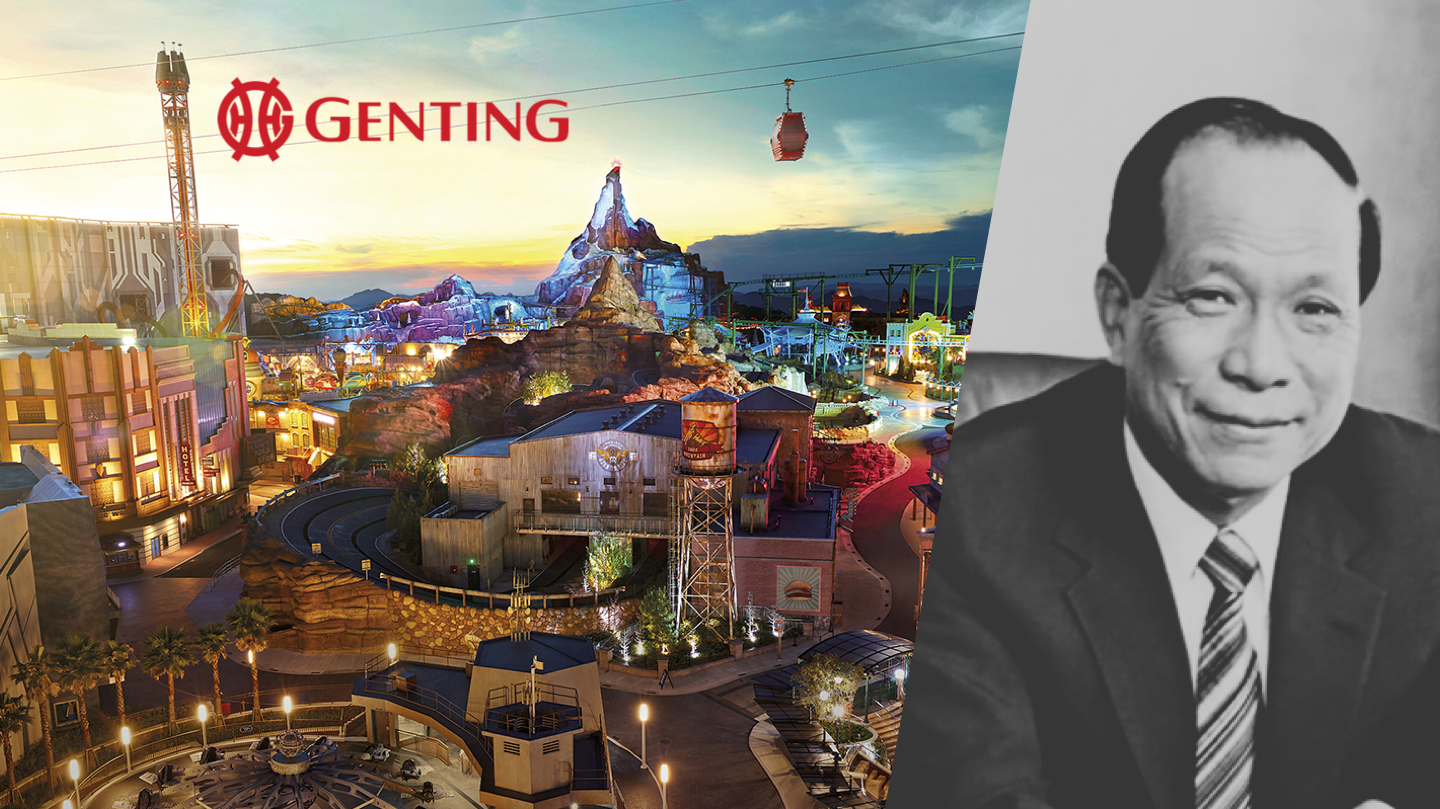
In 1970s Malaysia, Lim Goh Tong found a mountain and wanted to build on top of it. It didn’t even have any roads.
Obviously, everyone said he was mad.
But he still did it, and he walked away with Malaysia’s only casino license to date and built up an empire around it. By the time he died in 2007, he was Malaysia's third-richest man with a $4.3B fortune.
This is the story of Genting Group founder Lim Goh Tong and the political storm that nearly destroyed everything he'd built.
🌱 The fifth child who learned to survive
Lim Goh Tong was born in 1918 in Anxi, China. He was the fifth of seven children.
His father, Lim Shi Quan, ran a small business dealing in vegetable seeds, rabbits, and other items. His mother cared for the children.
"While my father was busy with his business, my mother held the fort at home, caring for her brood of seven children," Lim later wrote in his autobiography. "Despite her bound feet, she had to do a lot of heavy work. But she never complained."
When his father died, 16-year-old Lim was forced to leave school. He and his elder brother had to take over the heavy burden of feeding their family. Lim continued selling vegetable seeds to support them.
As China's situation worsened, Lim made the most important decision of his life. At age 19, he left for British Malaya.
He arrived knowing no one. He worked as a carpenter with his uncle for two years, learning the Malay language along the way. What he lacked in English, he made up for in discipline.
After gaining experience, he started as a building sub-contractor, completing his first job—a two-storey school—successfully.
After the war, Lim tapped into the construction boom, trading secondhand heavy machinery and equipment. He built a reputation not for being the loudest in the room, but for being the most reliable.
💡 The mountain that whispered
The idea came to him in 1963 while working on a hydroelectric project in Malaysia’s Cameron Highlands.
He felt the cool mountain air and relief from tropical heat. But it was four hours from Kuala Lumpur, which was too far for a weekend escape.
Cameron Highlands was beautiful but inconvenient. Malaysia's middle class was growing, and they’d pay for cool air without the long drive.
What if you could build something closer?
After doing research, Lim found Gunung Ulu Kali at a place called Genting Sempah—58 kilometres from Kuala Lumpur. It was steep, remote, and absolutely perfect.
His friends thought he was mad. Why build where no one could reach?
"The Genting project basically fitted my idea of an ideal business: no one was interested in it, which meant no competition," Lim would later write in his autobiography.
"To be sure, I do have a healthy appetite for risk taking that is quite uncharacteristic of a Chinaman businessman... I believe that to succeed in business, one has to be what the Chinese say dan da xin xi, be bold but cautious. Once a decision is made with sound reasoning, the rest is hard work, determination and perseverance to see it through to fruition."
🎲 The gamble nobody wanted
Lim set up Genting Highlands Berhad on April 27, 1965, together with Tan Sri Haji Mohamad Noah bin Omar.
With the support of Prime Minister Tunku Abdul Rahman, the Pahang State Government swiftly approved a freehold lease. Selangor initially offered only a 99-year lease, but Lim convinced the Menteri Besar that a freehold arrangement made more sense for such a long-term development.
But getting land was just step one. The challenge was building on it.
Engineers estimated the access road would take 15 years to complete, but Lim believed he could do it faster.
🚧 The mountain that fought back
Construction of the access road began on August 18, 1965. To finance it, Lim sold his 810-hectare rubber estate in Segamat for RM2.5 million ($560K). He invested every dollar from his other businesses. When money ran thin, he didn't cut corners.
The mountain fought him at every turn. It had a dense tropical jungle, no water, and o electricity. During the construction, Lim even claims that he survived several close encounters with death.
Some days, nobody knew if they'd finish. But he kept going. When contractors quit, he found new ones. When equipment broke, he sourced replacements.
On March 31, 1969, Malaysia's first Prime Minister Tunku Abdul Rahman made the climb to lay the foundation stone for the first hotel.
The road was done in less than four years, not the fifteen years everyone said it would take.
🎰 The afternoon that changed everything
Lim had planned a modest 38-room hotel, which was just enough to prove the concept.
Then the Prime Minister spoke: To help accelerate the development of this remote area, he said, the government would favourably consider an application from Genting to operate a casino.
Lim's mind raced. A casino? It would be Malaysia's first.
So, he made an immediate decision: upgrade from 38 to 200 rooms.
On April 28, 1969, Lim submitted his application. By coincidence, a cabinet meeting was being held that very afternoon.
Six hours later, the application was approved.
He had Malaysia's first and only legal casino licence. In a sense, he created his own luck.
He didn’t ask or beg for a license. But it only happened because he'd built a road that shouldn't exist to a mountain nobody wanted—which allowed the opportunity to come up.
🏨 The storm before opening
The resort was set to open in 1971. Everything was ready, from the casino and the 200 rooms to the staff.
Then, devastating rains hit. Landslides damaged the access road at numerous locations. Now, it had to be closed because the roads were impassable.
Lim didn't panic. He'd rebuilt before, and months of repairs followed.
On May 8, 1971, Highlands Hotel opened its doors. It was Malaysia's newest escape.
Malaysians came. City dwellers escaped the heat, gamblers tried their luck, and word spread.
By the late 1970s, going to Genting had become a family ritual. Families piled into cars on Friday evenings, windows down with kids asleep in the backseat. The winding road became as familiar as the destination itself.
Staff who'd helped build the place were now training the next generation of workers. The resort expanded—more hotels, more restaurants, more reasons to stay.
And for twelve years, Genting thrived. To anyone, it was clear that Lim's gamble had paid off.
🕌 The ban that threatened everything
Then, in September 1982, a headline appeared in the news: "Kasino akan ditutup"—Casino will be shut down.
The 1980s had brought a political shift. Islam became increasingly prominent in Malaysian politics. The Federal Territories Islamic Department was moving to ban Muslims from working at alcohol breweries and from selling drinks.
Genting's casino became a target.
By January 1983, steps had been taken to move the remaining Muslim staff at the casino to other departments like the hotel or restaurant.
On June 1, 1983, the announcement was official: starting June 8, Muslims would be prohibited from entering the casino.
Najib Razak, then Menteri Besar for Pahang, announced that the Sultan of Pahang had signed the order. Religious inspectors would be posted at entrances. Those who entered anyway would face fines up to RM250 ($55), three months in jail, or both.
Lim was 65 years old. He'd spent eighteen years building this. The casino was his core business. And now, a significant portion of his potential market was gone, just like that.
He didn’t panic, fight the government, or sell the business and move on.
Instead, Lim adapted. He'd learned something building that road: when the mountain fights back, you don't give up. You find another way.
Over the years that followed, Genting became more than a casino. They made sure everyone could still go to Genting and enjoy the cool mountain air.
They added theme parks, shopping, restaurants, and entertainment. This way, Muslims could still vacation at Genting—they just couldn't gamble.
What could have destroyed Genting made it stronger. When the rules change, you change with them.
🌍 The empire that grew
Over the following decades, Highlands Hotel became the anchor for multiple additional hotels. Indoor and outdoor theme parks. Convention centres. Cable cars.
The resort expanded, but Lim's principles didn't change.
The Genting Group expanded into plantations, power generation, oil and gas, property development, life sciences, and biotechnology.
In 2010, the group opened Resorts World Sentosa in Singapore—one of just two integrated resorts with a casino licence in the city-state.
Lim Goh Tong died on October 23, 2007, at Subang Jaya Medical Centre. An estimated 20,000 people, including royalty, politicians, and business leaders, paid tribute.
Lim had handed the reins to his second son, Lim Kok Thay, who became chairman on December 31, 2003.
In March 2025, Lim Kok Thay stepped down as CEO, appointing Dato' Sri Tan Kong Han—the first leader from outside the founding family.
📈 Today's Genting
Genting Berhad reported revenue of RM 27.7B ($6.2B) in 2024.
Genting Malaysia Berhad alone generated revenue of RM10.9B ($2.4B) in the same year, with a market capitalisation of approximately RM13B ($2.9B).
The leisure and hospitality division operates Resorts World properties across Malaysia, Singapore, the United States, the United Kingdom, and beyond, with leisure and hospitality accounting for over 80% of revenues and earnings.
The First World Hotel at Genting Highlands holds the Guinness World Record as the world's largest hotel by room count, with 7,351 rooms.
All because Lim Goh Tong bet on a crazy idea to build on top of a mountain that didn’t even have roads.

The newsletter that keeps you up-to-date on the top stories on tech and business in Southeast Asia. It's fun, quick and free.
