_transparent.png)


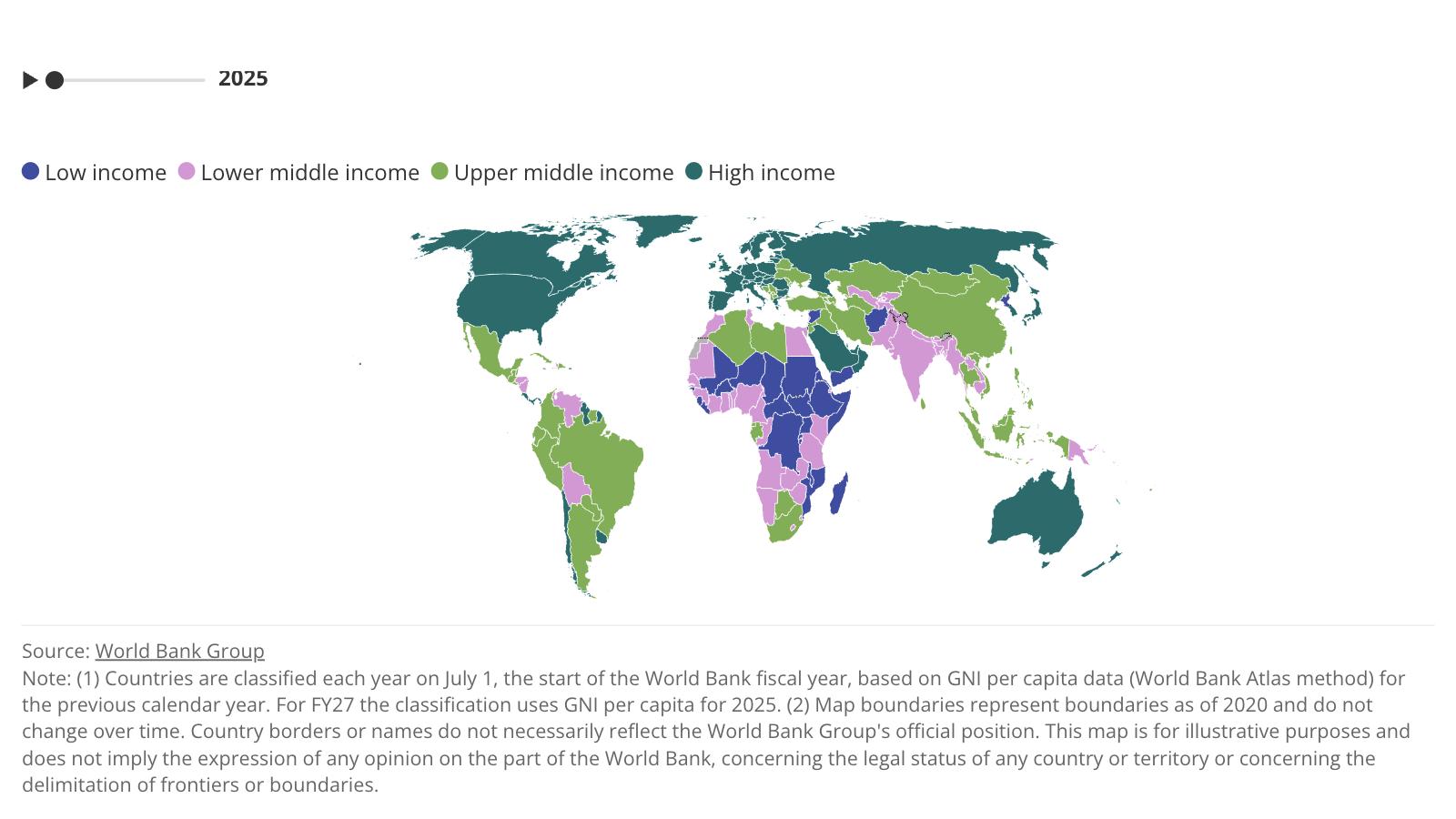
Moving on up! On 1 July, the World Bank bumped both the Philippines and Vietnam from lower-middle to upper-middle income.
So where's everyone else? The World Bank has been publishing these rankings since 1988, and most of the region has not budged.
🗺️ Want to see the whole map? The World Bank has an interactive version where you can slide through the years and watch countries change colour.
🎢 Indonesia's wild ride
Indonesia reached upper-middle in July 2020. It fell straight back out a year later, in the middle of the pandemic, and only climbed back in July 2023.
This table moves both ways.
Fast and slow. Vietnam was a low-income country as recently as 2010. The Philippines is the other story. It had been lower-middle in every single ranking the World Bank ever published, 38 years running, until this month.
📖 The concept: the number can't see where the money came from
Gross national income counts everything a country's residents earn, including what they earn abroad. So a wage from a factory in Bac Ninh (a manufacturing province in northern Vietnam) and money wired home from Dubai by a Filipino nurse land in exactly the same place.
It's also an average. Nobody actually earns it. Vietnam's income per head being $4,970 tells you nothing about what any Vietnamese person takes home.
Two countries, different paths. Vietnam's statistics office puts manufacturing value added up almost 10% last year, with the economy growing 8%.
Looking back. In 2023, the Philippines was $180 ahead of Vietnam. By 2024, Vietnam had passed it. By 2025, Vietnam is $120 ahead.
Neither is having a super great 2026. The Asian Development Bank has already cut its Philippine growth forecast from 5.3% to 4.4%.
And these lines are thin. The Philippines cleared the boundary by $214. The finish line moves, too. The high-income threshold was $12,536 six years ago. Today it's $14,375, because the brackets get adjusted for inflation every year.
🚪 So what happens next?
Upper-middle income is a very wide room, running from $4,636 to $14,375. Plenty of economies do get out. Since 1988, 38 have climbed from upper-middle to high income. South Korea in 1996. Poland in 2010. Chile in 2013. Romania in 2020. Bulgaria in 2024. Costa Rica last year.
Not one of them is in Southeast Asia.
Malaysia has been upper-middle for 33 years. Thailand for 15. Economists call this the middle-income trap: cheap labour gets you to the middle, and getting past it takes productivity, which is a lot harder to build.
Singapore and Brunei were already high income on the World Bank's first list. Nobody from the region has joined them since.

The newsletter that keeps you up-to-date on the top stories on tech and business in Southeast Asia. It's fun, quick and free.
